Katrina was a just a little girl excited for a train ride when the realisation dawned on her that people saw her as different.
“I saw the word ‘handicapped’ on my ticket and asked my dad what it meant,” she signs. “Even though he explained it, I still didn’t understand because to me it’s just my ears that don’t work, everything else is fine.”
Katrina’s ears may not work but her hands and expressions sure do, and she loves to tell a story. It’s lucky for those who hear that interpreter Teresa is with Katrina for The Deaf Experience. She is the bridge between two worlds, helping the deaf and the hearing to communicate.
In her chosen language of Auslan, Katrina signs for over an hour about her experience living as a deaf person, from cultural identity and the importance of Auslan to social inclusion and the importance of technology to workplace attitudes, communication barriers and navigating NDIS and bureaucracy.
At the end of her first story Katrina turns to the wall beside her and sticks a Post-it note. For that little girl and her realisation, she signs.
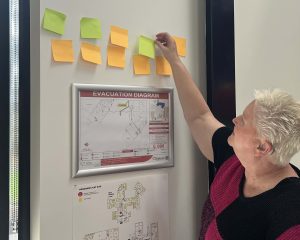
Katrina does this at the end of a number of other stories too – for parents of deaf children who are expected (not helped) to advocate for their child; for the hearing son who was expected by others to speak for his deaf mum; for the little boy who couldn’t leave school to start a trade because the school needed three deaf students enrolled to receive specialist funding support; for those who are ageing out of the NDIS system and into the Aged Care system which many are finding aren’t catering to their needs.
By the end of the presentation there are 10 Post-it notes in total stuck to that wall, although there are likely many more she could put up.
Never has a Post-it note been poignant, until now.
“This is a visual representation of my life,” signs Katrina. “They represent moments in time, burdens, placed on me during my life, and on my community, because the burden is always on us to fit in with you. I wonder how many Post-it notes you need to put up?”
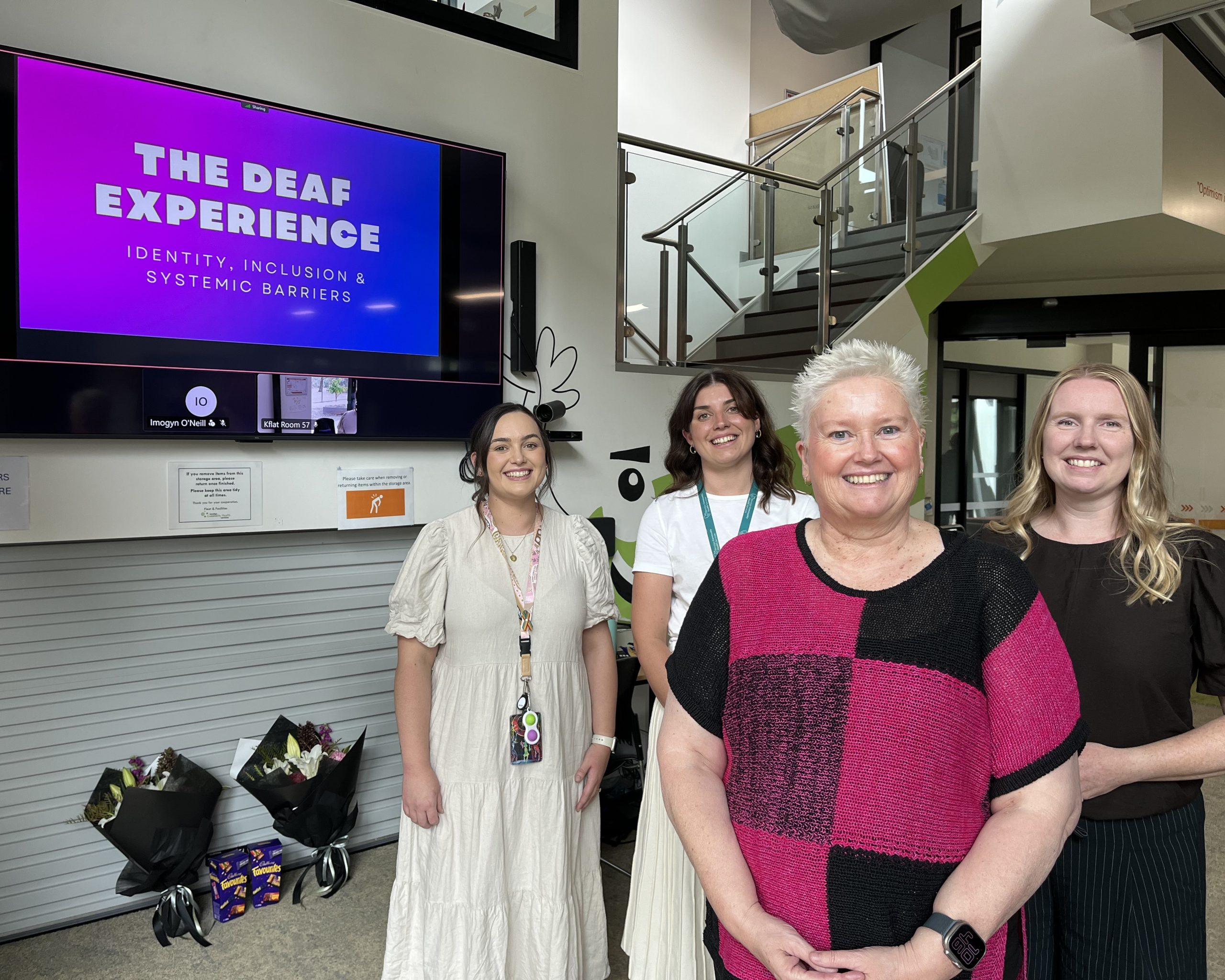
 Facilitated by Bendigo Community Health Services (BCHS) and Anglicare Family Services Specialist Disability Practitioners, Emily Mynard and Imogyn O’Neill, The Deaf Experience presentation was more than work for Emily, it was personal.
“There’s nothing more powerful than hearing from someone with lived experience,” she says. “And I’m not just saying that because Katrina is my aunt.
“With The Deaf Experience we wanted to bring awareness of and insight to the deaf community, the barriers they come up against time and again, as well as the importance of having access to local services.
“Katrina has so many stories, has worked in this space for 25 years and has been a passionate advocate her whole life so is able to speak to all of those things.”
Somewhat ironically the presentation, which was available in person and online, had tech trouble right from the start, with those online unable to hear interpreter Teresa very well.
“That was definitely not part of the plan,” laughs Emily. “But honestly, it ended up being a great first-hand example of what Katrina has to deal with daily.”
Emily is also a bridge of sorts. As BCHS’ Family Services Specialist Disability Practitioner she supports other practitioners part of the North Central Victoria Family Services Alliance (NCVFSA) by helping to create understanding and connection between disability and family services. This in turn strengthens understanding of the NDIS which is incredibly important for those who live with a disability.
“Bridging that gap in knowledge for practitioners and families is so important,” Emily says. “It allows practitioners to better support families to access, navigate and meaningfully engage with the NDIS.”
It’s an approach that ensures children and parents with a disability are better understood, included and empowered, while also lifting the capability and confidence of the Family Services sector.
“I work with practitioners from five organisations throughout the Loddon Mallee region and together we consult, plan tailored guidance and problem solve to get the best outcomes for our clients,” Emily says.
“I’m really lucky to be part of a team that backs me in this work. That support makes a huge difference because so many of the families we support are trying to juggle incredibly complex systems while also trying to meet their child’s everyday needs.
“Growing up I saw the kinds of barriers Katrina talks about in The Deaf Experience, the ones that really should be basic human rights, not hurdles that families have to climb.
“It’s busy work, but it’s meaningful. The demand never really slows down because the support that we’re advocating for can genuinely change the direction of a person’s life.
“That’s a big part of why I do what I do. Every day I’m trying to break those barriers down so families don’t have to carry that burden alone.”
Advocacy fatigue is real, confirms Katrina, and can lead to mental health struggles within the deaf community. But working together – with people like Emily, Imogyn and the NCVFSA – to break down barriers will lessen the load and build inclusion into everyday life.
“We are allies and we need each other,” she declares of the deaf and hearing communities. “We need people to fight for us. We need people to ask us what we need, to accept what we need, to build a space that’s designed by us, for us; that’s real inclusion.
“At the end of the day, empowering deaf people to live life on their own terms and to make their own decisions is the best thing for our community.”
Emma Sartori
March 30, 2026