In a significant show of support for its need, BCHS’ pioneering Cancer Support for People of Refugee Background program has received millions in funding from the state government.
“This is truly life changing funding for our former refugee communities, and we’re so grateful,” says BCHS CEO Mandy Hutchinson.
BCHS’ Multicultural Health Equity team first embarked on the program three years ago, aiming to make cancer prevention, screening and treatment accessible for people of refugee backgrounds.
With no word for ‘cancer’ in Karen, an intimidatingly complex health system to navigate, and a fear-based belief born in refugee camps that a cancer diagnosis means certain death, losses began to climb for the Karen community in particular, with many hitting close to home for BCHS’ bicultural staff.
The challenges were clear from the beginning, says Multicultural Health Equity Project Lead Abbie Lockwood, and so partnerships were built with Loddon Mallee Integrated Cancer Services, the Bendigo Regional Cancer Centre and Bendigo Health to ensure the then-fledgling pilot could take off. And take off it did.
“The project has just been so much bigger than anything we thought it was going to be,” she says. “We were seeing an increase in late-stage cancer diagnoses, particularly within the Karen community. Early symptoms weren’t being recognised, people were frightened and not seeking timely care, they were also finding it hard to engage with treatment services.
“We knew what we wanted to change, and it feels like we did a thousand other supporting projects along the way, but everything we’ve done is reflective of the work that needs to be done, especially if we want to see true change in screening, in people getting an early diagnosis and then getting treatment.”
Hope restored
After conducting a needs analysis and receiving overwhelming feedback like: “Everyone with cancer will die so there is no point getting treated,” the team set about building health literacy wherever they could.
From community sessions – 56 cancer prevention screenings were held in just two years – to the classroom, where cancer-specific modules were built into the Adult Migrant English Program. Competencies across all agencies were also strengthened – from understanding how both the Karen and Afghan communities engage with health services, to improving health knowledge for interpreters, to learning how to navigate the different health care systems.
And now, the proof is in the pudding.

“Three years on, screening rates are up. People are reaching out to us for support when they get a letter or a diagnosis. The hospital is now ringing us to assist when they get a referral. People are doing things independently of us because of the work we’ve put in over the last few years.
“Our former refugee communities have knowledge; they understand where they need to go and the services involved. It’s amazing.”
The gamechanger
Trust has been an integral part of the program, and it grew from the wraparound care BCHS has provided new arrivals for 16 years now through staff of lived experience within our Multicultural Health Equity and Settlement Services teams.
“Our staff really are incredible,” says BCHS Multicultural Health Equity Senior Leader Kaye Graves. “We’ve worked with Bendigo’s former refugee communities for years now and we are proud to do so.
“While we recognise there needs to be improvements in all matters related to cancer care, what we have achieved with the program so far has been because an eager community want to learn, because we co-design everything with our staff of lived experience and because we have incredible partners.”
“One hundred percent our bicultural staff have made this program what it is,” Abbie adds. “We understand that we need to work with people in a way that’s appropriate for them, and the trust the community has in our bicultural staff, and as an extension our partners, has increased engagement and changed lives, no doubt.”
"You do not have to walk the cancer treatment path alone'
Boe Htoo is just one of those bicultural workers. In her role she supports the Karen community to learn about cancer as well as advocating for those diagnosed with cancer when navigating health services. She has lived refugee experience and sees both sides to this issue. One client currently receiving cancer treatment had this to say about the importance of the program and Boe Htoo’s role.
“I first heard about the program when I attended the education sessions. When I got my diagnosis at the hospital, they asked if I wanted support from community health and I said yes because I already knew about the program, and I already knew the staff.
This program is like a bridge to cancer care because the navigator always guides us, gives us encouragement and speaks on our behalf to clarify things that confuse us. Because of this I feel more confident accessing cancer care, and I feel safe and comfortable every time we visit the Cancer Centre.
Without this program my experience would’ve been very difficult. My family is very supportive, but it is not enough compared to this program because of the language barrier and because of our limited literacy and health knowledge.

Funding that will make a difference
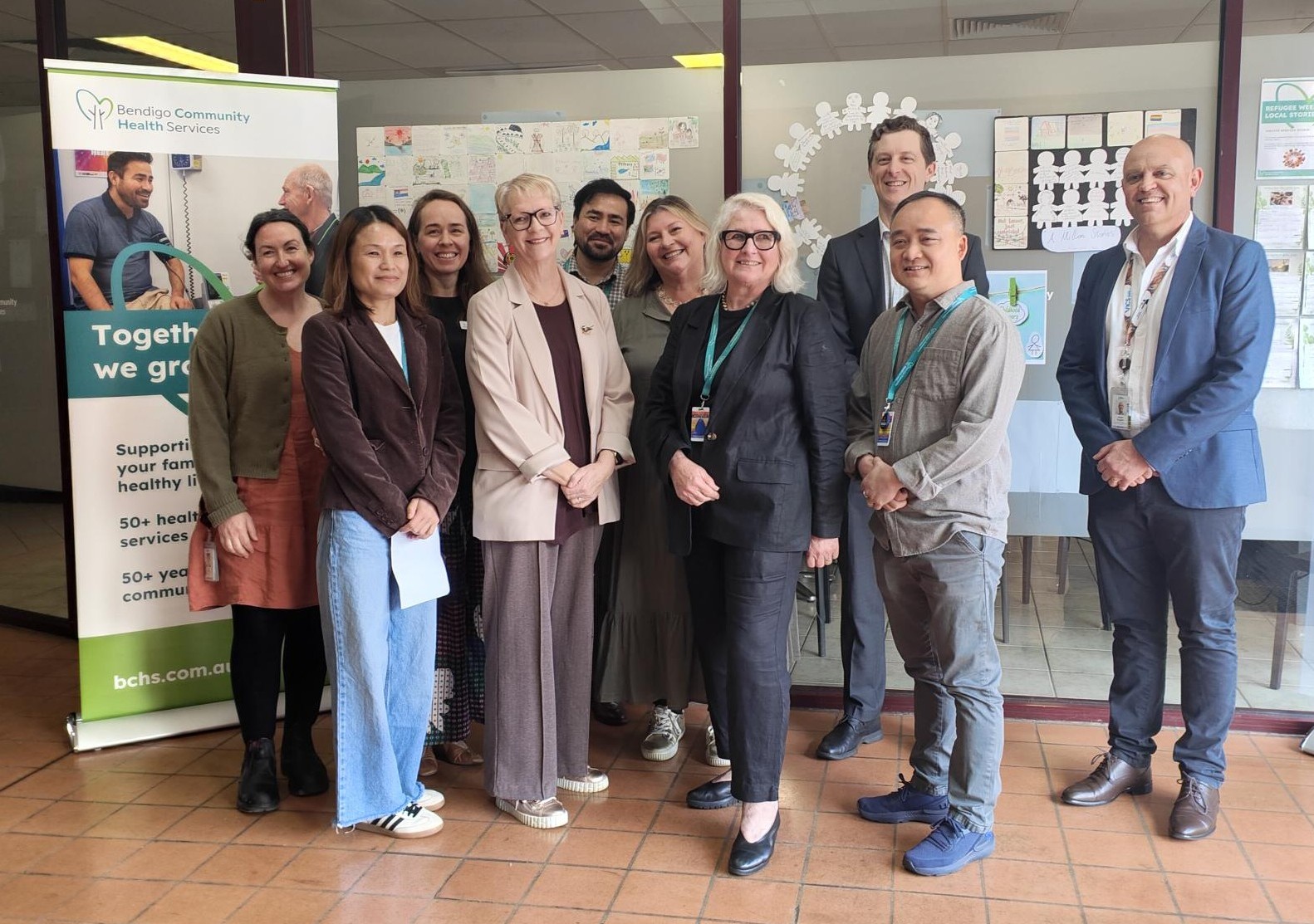
Making the announcement at BCHS’ Central site, Member for Bendigo West Maree Edwards said the money came as part of the Victorian Government’s Cancer Strategy.
“The State Labour Government is very proud of this work,” she said. “Bendigo Community Health Services is well renowned for their support of our refugee community in a whole range of different areas; this is just one of them. But this one is really important. The pilot was hugely successful and proved that there was a desperate need to ensure that particularly people from refugee backgrounds had access to good knowledge, education, cancer supports, cancer awareness and preventative measures.
“Cancer touches too many people, too many lives, mine included… there is nothing more important than making sure it doesn’t matter where you come from, it doesn’t matter your background, doesn’t matter where you live, that you have equitable access to the same services that everyone else has access to.”
Abbie, Kaye and Boe Htoo can’t wait to move forward with the project. There’s so much more to do.
“We really are thrilled to be receiving this new state government funding,” Abbie says. “It’s going to allow us to continue to challenge barriers, build confidence, education, trust and self-determination for our former refugee communities here in Bendigo.
“We’ve got a community of potentially 4,000 Karen, about 300 Afghans and new families constantly arriving so our work isn’t done.”
There’s an even bigger take away from the program too, one that wasn’t expected.
“The work that we’re doing supports everyone,” she says. “It’s not just about educating our Karen and Dari speaking communities. Our work is also changing the way that health care professionals look at working with a patient, or it’s making organisations look at changing procedures and ways of working that will support all diversities.”
Top photo: From left, Lisa Carson – Refugee Cancer Support Bendigo Health; Boe Htoo – BCHS Multicultural Health Equity Project Worker; Abbie Lockwood – BCHS Multicultural Health Equity and Relationships Facilitator and Project Lead; Maree Edwards – MP for Bendigo West; Zahir Azimi – BCHS Multicultural Health Equity and Relationships Project Worker; BCHS CEO Mandy Hutchinson; Kaye Graves – BCHS Senior Leader Multicultural Health Equity; Nido Taveesupmai – BCHS Multicultural Health Equity Project Worker; Chris White – Bendigo Regional Cancer Centre Director; Adam English – Strategic Manager Loddon Mallee Integrated Cancer Service.
by Emma Sartori, September 14, 2026